

The Future of Physical AI in Transportation and Freight

This series began by drawing the line between digital AI and physical AI, then showed how that line resolves in freight: physical AI is not a new arrival, it is the destination the trucking industry has been building toward for decades. This piece closes that arc — tracing how the shift plays out across the full freight ecosystem, and why it starts where the series said it would: on the highway, not the warehouse floor.
Because freight has never been a digital-only problem. It has always been a physical one.
From Information to Interaction
Why Freight Is a Natural Fit
The Beachhead Is the Highway and The Rest of the Ecosystem Follows
A lot of people think about physical AI in freight and jump straight to autonomous trucks. That’s not wrong — it’s where TorcDrive, and the physical AI destination this series has been describing, is proving out first: on high-volume interstate corridors and predictable long-haul lanes. But autonomous trucks are the leading edge, not the whole story.
The future of AI in freight is broader than one vehicle or one use case. As the operational envelope expands beyond the highway, it includes:
• Warehouse robotics that can understand changing environments
• Yard systems that can coordinate movement more intelligently
• Predictive maintenance tools that can interpret physical signals before equipment fails
• Load optimization systems that adapt to operational constraints
• Safety systems that detect risk in real time
• Material handling systems that can perform more than one task
• Decision support tools that help people act faster and with more confidence
That is the real strategic shift. Physical AI is not just about making one machine smarter. It is about making the entire freight ecosystem more adaptive — starting from the proven beachhead outward.
Why It Will Scale in Stages
One of the most important things to understand about physical AI is that it will not scale all at once.
The freight industry has seen enough technology cycles to know that adoption follows a pattern. The first step is usually proving value in a controlled environment. The next step is expanding into adjacent use cases. Then the technology broadens into more variable and more complex settings.
Physical AI is following that same arc — and freight is a live example of it.
It starts where the environment is more structured and the operating domain is narrower — which, in freight, can mean high-volume interstate corridors and predictable long-haul lanes before it means anything else. That’s not a generic adoption pattern; it’s the specific sequence physical AI is already following in trucking today, and why autonomous highway operation is the furthest along of any freight application.
From that foundation, warehouses, yards, and other constrained settings become the next expansion, because they offer their own version of the same combination: clear boundaries, measurable outcomes, manageable risk.
Over time, as systems learn and improve in each of those domains, the scope keeps expanding — and the domains start to connect.
That is not a limitation. It is how real adoption happens. The future of physical AI will not be defined by one massive leap. It will be defined by a sequence of practical, valuable steps that gradually build trust and capability, starting from the highway and moving outward.


The Importance of Design Domain
Read this twice: physical AI will always operate within a design domain.
That matters because freight is not a laboratory. Real operations involve cost, risk, uptime, safety, and service commitments. Any technology that operates in that setting has to be designed with limits in mind.
The right question is not whether physical AI can do everything. The right question is where it can do something useful, reliably, and safely.
That is why the future of physical AI in transportation and freight is shaped by domain-specific deployment. For Torc, that domain starts on the highway — TorcDrive is built and proven for long-haul interstate operation first, with the same design-domain discipline expanding to warehouse floors, yards, terminals, and customer sites over time.
This is also why the future of freight AI will not be about a single universal platform. It will be about a growing set of systems, each built for its own operational context, but all driven by the same underlying shift: learning in the physical world, proven in the domain where it’s most ready before it expands into the next.
What Freight Leaders Should Be Watching
For freight executives and operators, the question is not whether physical AI is coming. It is already here in early forms.
The more useful questions are:
• Where are our most repetitive physical workflows?
• Where do exceptions create the most cost and delay?
• Where do we lack visibility?
• Where would better real-time interpretation improve operations?
• Which environments are structured enough for early adoption?
• What data are we already collecting, and what are we missing?
Those questions matter because the future of physical AI will not be won by hype. It will be won by operational clarity.
The companies that benefit first will be the ones that understand their workflows deeply enough to identify where intelligence can create measurable improvement.
Once that data became accessible, AI systems could be trained quickly and at scale.
That’s why digital AI feels like it “appeared overnight.” It was trained “in the cloud” of ever-expanding data centers, allowing for rapid iteration.
Simulation Will Be a Major Accelerator
A key factor behind the future of physical AI is simulation.
Because physical-world data is harder to collect than digital data, simulation becomes a powerful way to train systems before they ever operate in live environments. That matters enormously for freight, where testing in the real world can be expensive, disruptive, or risky.
Simulation gives organizations the ability to create realistic operational conditions without needing to reproduce every experience physically. It allows AI models to encounter rare scenarios, learn from edge cases, and improve faster than they could through real-world trial and error alone.
At Torc, this is exactly how TorcDrive trains: on real-world data and complex simulated scenarios simultaneously, so the system encounters rare and safety-critical situations at a scale no on-road testing program could match alone.
That means the future is not just about more sensors or more hardware. It is also about better ways to create, train, and refine intelligence before it is deployed.
The Human Role Will Still Matter
As powerful as physical AI may become, freight is still a human industry.
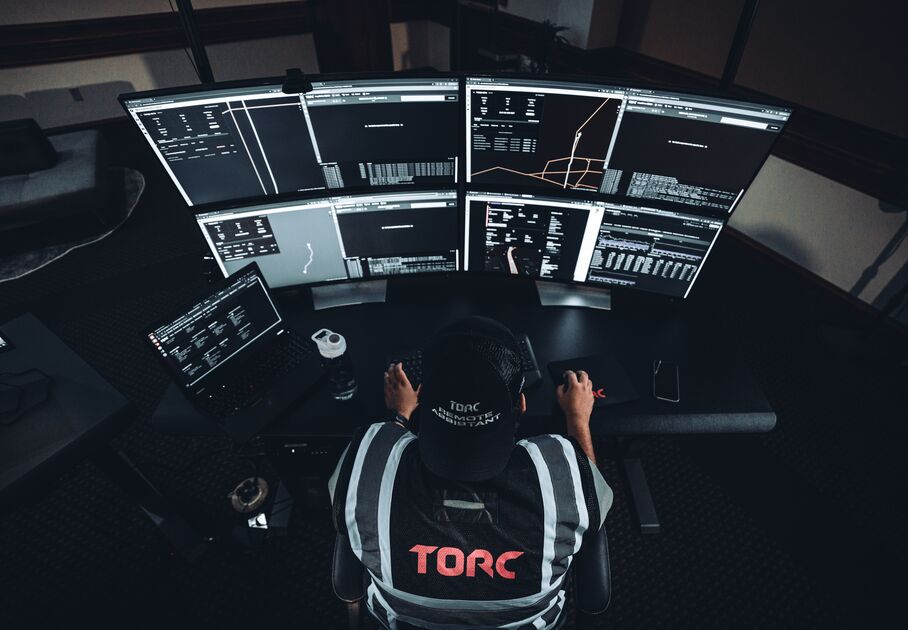
Drivers, planners, warehouse teams, dispatchers, maintenance staff, and operations leaders are not disappearing from the picture. If anything, their roles are becoming more important as the complexity of the system grows.
The most likely outcome is not that physical AI replaces people wholesale. It is that it changes what people spend their time doing.
That shift matters.
When systems take on more of the repetitive sensing, monitoring, or coordination work, humans can focus more on judgment, escalation, planning, and exception handling. That is where freight organizations can create a better balance between efficiency and resilience.
The future of physical AI is not just about machine capability. It is about how machines and people work together in environments where both matter.

The Bottom Line
The future of physical AI in transportation and freight is not a distant concept. It is the next layer of a broader shift already underway.
Digital AI taught us what machines can do with language, data, and information. Physical AI is showing us what they can do when they are connected to the real world.
For freight, that future is especially significant. This is an industry built on movement, coordination, and execution. It is an industry where better decisions can create real economic value. And it is an industry where the challenge has never been a lack of complexity — it has been how to manage that complexity better.
That is the destination this series has been describing since its first piece: not a detour from decades of automation investment, but where that investment was always leading. At Torc, TorcDrive and AV 3.0 are how that destination is arriving first — on the highway, in the segment of freight where the case for physical AI is proven today — with the rest of the ecosystem following the same arc behind it.
Physical AI will not eliminate freight’s complexity. But it will help freight organizations navigate it with greater intelligence, resilience, and precision.
And that may be the most important future of all.

